Illustrative scenario — not a customer deployment. The workflow is proposed; no measured results are claimed. Site compatibility, detectors and workflows would be validated during scoping.
01 / THE OPERATING CHALLENGE
What needs a clearer view?
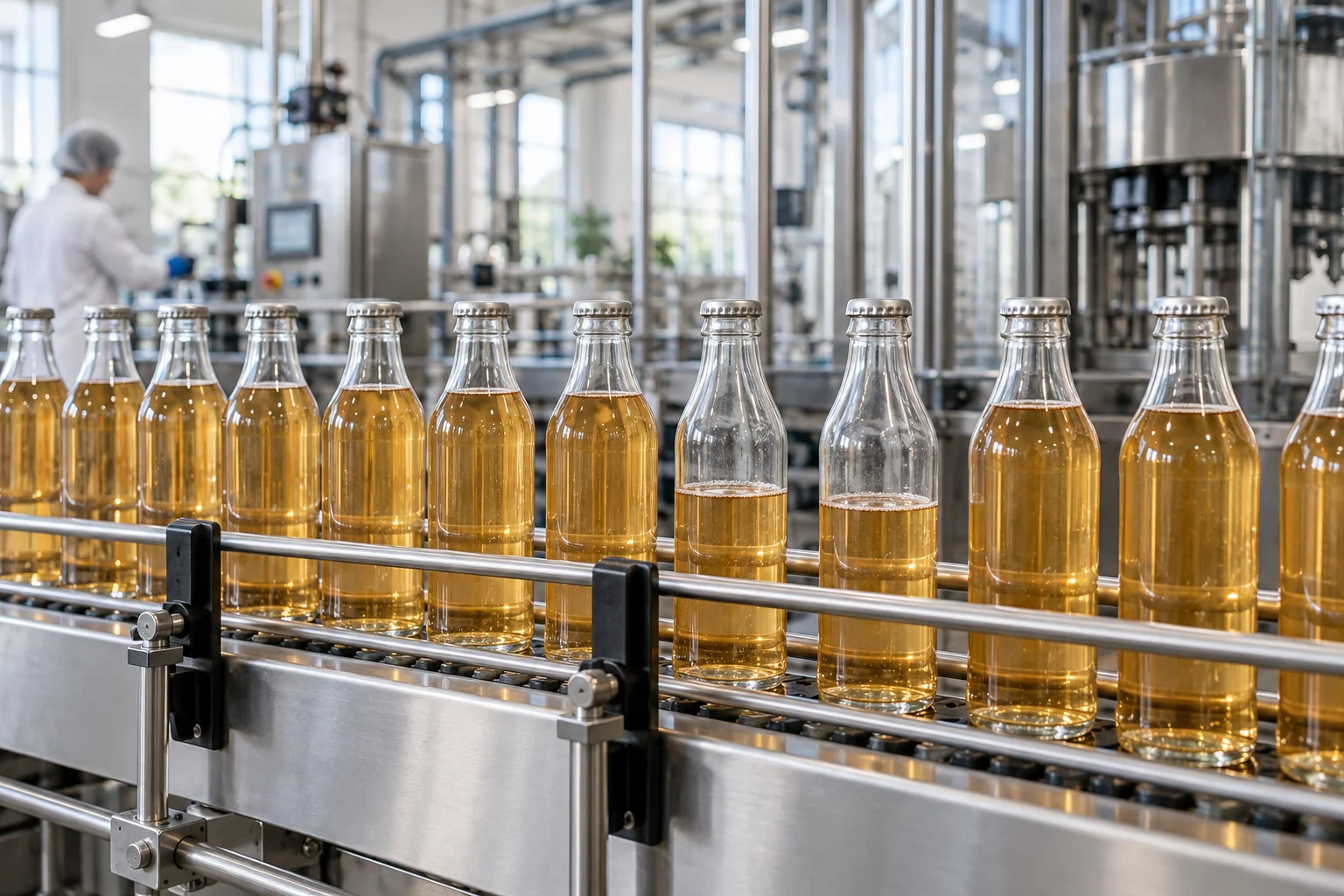
An illustrative beverage producer wants an additional visual check at a stable point on a small bottling line.
A process drift may affect successive containers before an operator performs the next sampling check.
Reflective packaging, labels and irregular bottle shapes make casual visual estimates unreliable.
02 / HOW iOn WOULD HELP
Connect the view to the workflow.
Stabilize the view
Use a suitable camera angle, repeatable lighting and a defined bottle type.
Calibrate against references
Compare visual fill-height candidates with independently measured accepted and rejected samples.
Review before intervention
Link exceptions to a time and production batch for a quality technician; do not automatically release or reject product.
03 / AN ILLUSTRATIVE EVENT
From a signal to a human decision.
Camera signal
A visible bottle’s fill-height candidate falls outside the band validated for that product.
iOn context
A time-stamped candidate, its location and supporting image would go to the responsible reviewer. Unclear or obscured views stay unresolved.
Human action
The technician checks a physical sample, considers the batch history and decides whether the line needs adjustment or further inspection.
Example sequence only. No live feed, customer incident or recorded outcome is shown.
04 / MEASURE BEFORE YOU EXPAND
What would make the pilot useful?
Agree definitions and a baseline before starting. Review uncertainty and other operational changes alongside any observations.
Agreement with inspection
Compare visual candidates against measured samples across bottle types.
Is the signal reliable enough to assist the team?
Detection-to-review time
Record when a candidate occurs and when a technician verifies it.
Can the process drift be investigated earlier?
Proposed evaluation measures. No numerical target or achieved improvement is asserted.
05 / READINESS & LIMITATIONS
Be clear about what the camera can tell you.
What the site would need
- Authorized camera access, suitable lighting and an agreed view of the target area.
- A named reviewer and documented privacy, access and retention arrangements.
- A pilot dataset representative of normal conditions, busy periods and visual obstructions.
What this scenario does not claim
- Visible fill height is not the same as certified volume or weight.
- Opaque containers and obstructing labels can make inspection unsuitable.
- This does not certify food safety, legal metrology or product quality.
Further reading
Concept inspiration: EyePop.ai: Inspecting Bottle Fill Levels. This is an independently written iOn implementation scenario, not an EyePop customer result, integration claim or endorsement.
06 / THE PILOT PLAN
Start with a defined question.
Start at one location. Collect a baseline, agree event definitions and compare reviewed alerts with independent observations across comparable operating periods. Record false alerts and missed events before considering expansion.
Expand only when reviewers can act on the signals, the evidence supports the agreed performance requirements and deployment safeguards are in place. No measured customer result is claimed.
Custom quote. Scope and commercial terms are agreed before commitment.