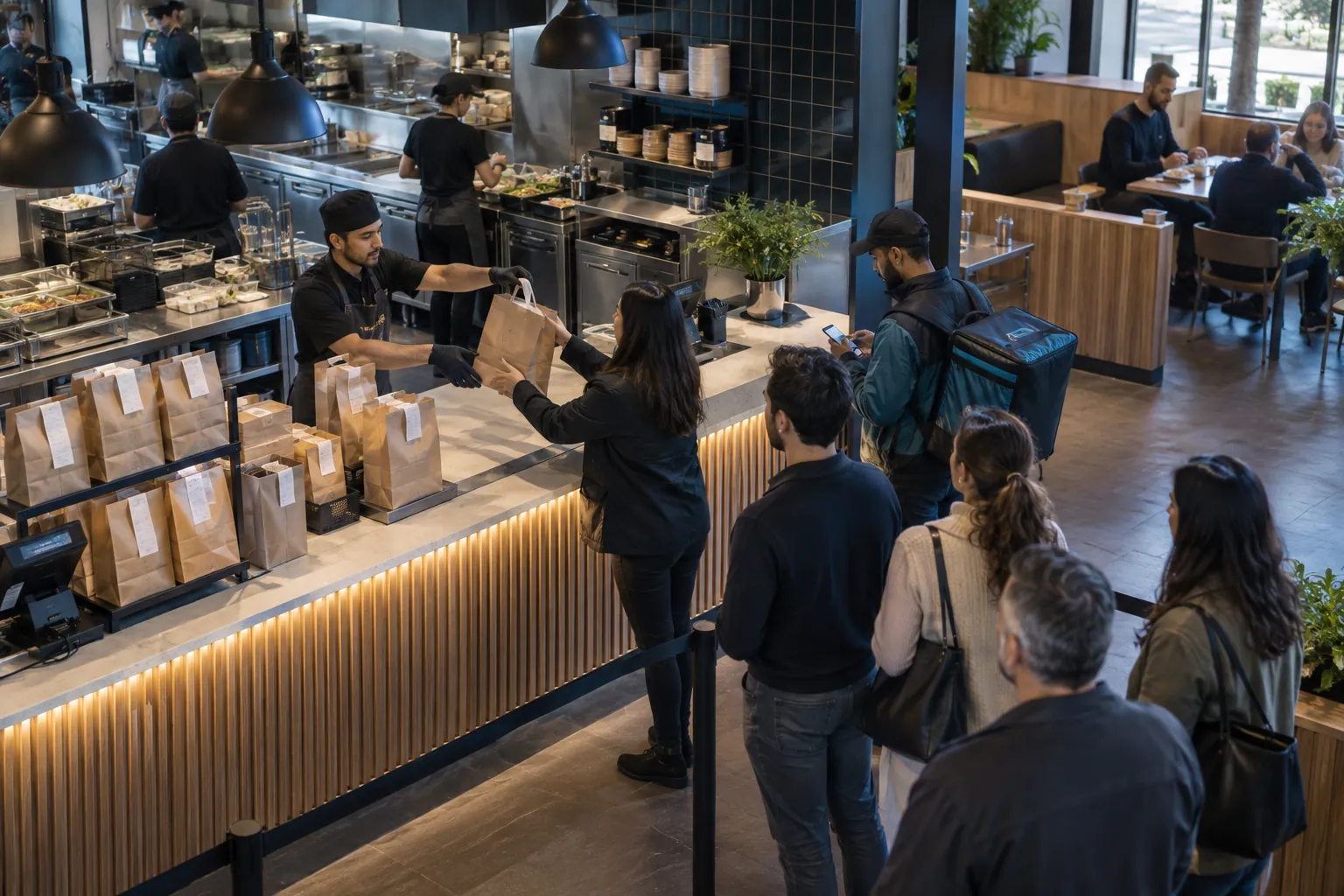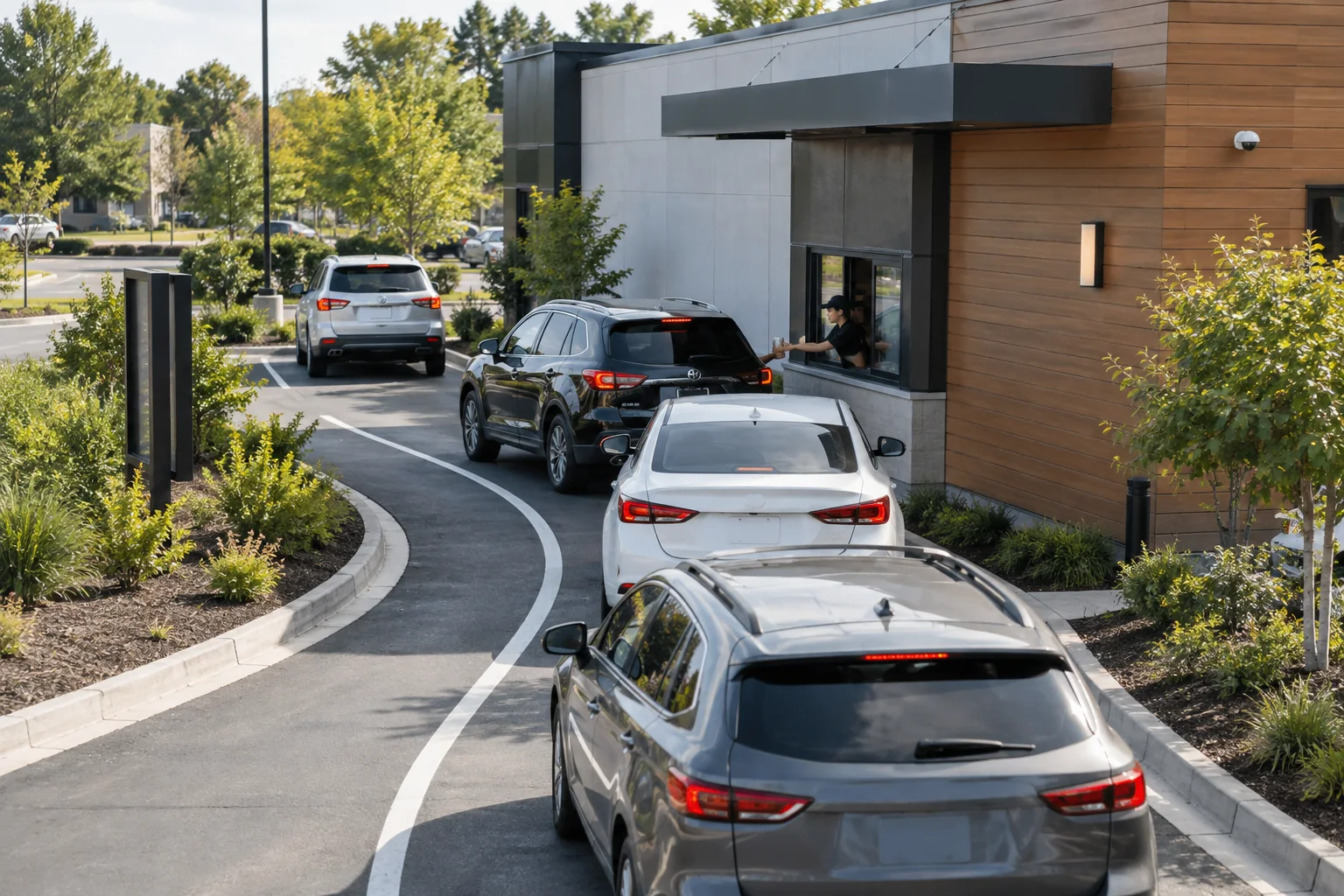
Illustrative scenario — not a customer deployment. The workflow is proposed; no measured results are claimed. Site compatibility, detectors and workflows would be validated during scoping.
01 / THE OPERATING CHALLENGE
What needs a clearer view?
An illustrative quick-service restaurant has an entrance camera and a view of its ordering and pickup lanes.
During a rush, a manager at the counter cannot see when the drive-through line begins blocking the shared parking area.
A queue count alone does not explain whether the hold is at ordering, preparation or collection.
02 / HOW iOn WOULD HELP
Connect the view to the workflow.
Define the lane
Mark the expected queue area and the points where overflow affects other traffic.
Compare observations over time
Review successive frames for queue occupancy and movement, linked to the same clock as operating records.
Route an actionable alert
Send a sustained overflow candidate to the shift manager, with the location that needs checking.
03 / AN ILLUSTRATIVE EVENT
From a signal to a human decision.
Camera signal
The visible queue remains outside the agreed lane boundary across repeated observations.
iOn context
A time-stamped candidate, its location and supporting image would go to the responsible reviewer. Unclear or obscured views stay unresolved.
Human action
The manager verifies the scene, coordinates the collection team and checks whether a blocked lane or delayed order is causing the hold.
Example sequence only. No live feed, customer incident or recorded outcome is shown.
04 / MEASURE BEFORE YOU EXPAND
What would make the pilot useful?
Agree definitions and a baseline before starting. Review uncertainty and other operational changes alongside any observations.
Queue overflow
Record reviewed overflow events and their duration.
Does the team recognize a hold sooner?
Wait measurement
Use validated timestamps or order-system records, not a single image estimate.
Are comparable busy periods moving more consistently?
Proposed evaluation measures. No numerical target or achieved improvement is asserted.
05 / READINESS & LIMITATIONS
Be clear about what the camera can tell you.
What the site would need
- Authorized camera access, suitable lighting and an agreed view of the target area.
- A named reviewer and documented privacy, access and retention arrangements.
- A pilot dataset representative of normal conditions, busy periods and visual obstructions.
What this scenario does not claim
- One still image cannot reliably measure actual wait time.
- Occlusion, glare and vehicles passing through can distort counts.
- This is an operational aid, not traffic control or an emergency response system.
Further reading
Concept inspiration: EyePop.ai: Drive Thru Queue Health. This is an independently written iOn implementation scenario, not an EyePop customer result, integration claim or endorsement.
06 / THE PILOT PLAN
Start with a defined question.
Start at one location. Collect a baseline, agree event definitions and compare reviewed alerts with independent observations across comparable operating periods. Record false alerts and missed events before considering expansion.
Expand only when reviewers can act on the signals, the evidence supports the agreed performance requirements and deployment safeguards are in place. No measured customer result is claimed.
Custom quote. Scope and commercial terms are agreed before commitment.